What Crowded House taught me about anxiety, choice and freedom
Before Zoom and I (and, probably, Zoom and you) were the close colleagues we became, I had a first impression that really stuck with me. Everyone in my Teaching Creative PGCert was invited to bring an object along to the introductions. The result was not just a group of strangers, but a group of implied stories.
This was mine:
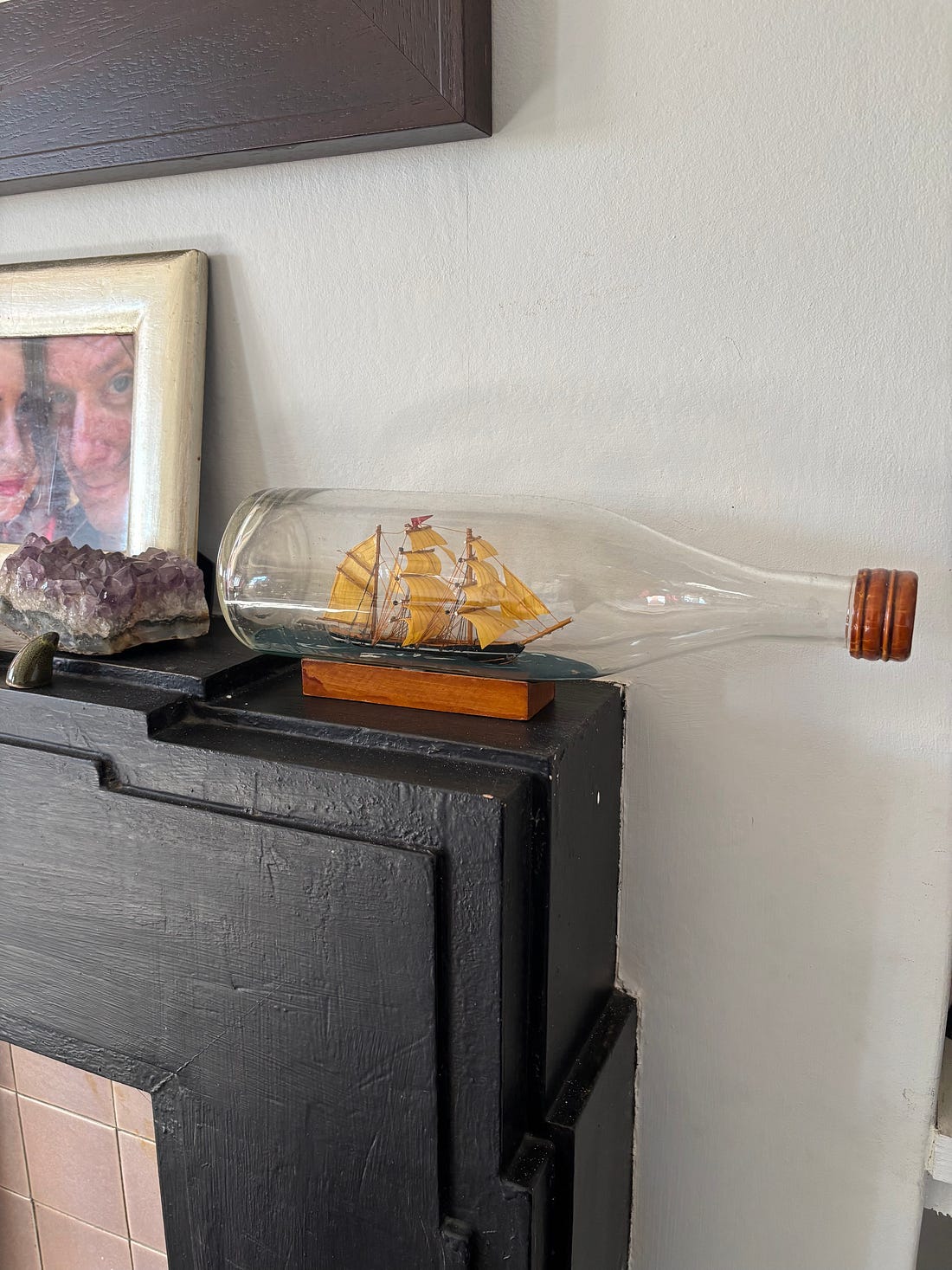
Its true story isn’t what makes it so special (although, now I think about it, that too meant something about stories: I stuck up for it when it was being purchased for a theatre set, against a bigger and cheaper version. I offered to pay the difference and while it’s been borrowed back for another theatre outing since, we’ve been together almost as long as I’d been alive when it was purchased).
What makes it special for me is something I first verbalised in hearing these lyrics:
Well there’s a small boat made of china, it’s going nowhere on the mantelpiece / Well do I lie like a lounge-room lizard, or do I sing like a bird released?
Weather With You, Crowded House
The question mark is important bit for me. In our worst times, when things are at their most hopeless and overwhelming, we tend to feel least like we have choice. My most hopeless and overwhelmed moments have tended to be very lonely ones. In them, I’d seek external approval. Which often meant sinking further, because if the external opinions differed or didn’t sit right, I felt more alone and with more decision paralysis than I began. But there is a choice, and it’s not a dangerous or terrible thing that I’m the only one who can truly make it for myself. That’s why I love the question mark at the end of that. It reminds me that choice is always there, swimming beneath the surface of whatever’s going on right now. It’s why such questions as these are so powerful:
‘If I knew what I chose would work out absolutely fine, what would I do next?’.
We are not, the song reminds me, inanimate objects, which means who we are today is not the same form of us as yesterday or tomorrow.
It also means our stories aren’t set in stone (or china).
Which leaves me this question:
“Where in my life might my fear or anger be getting in the way of my curiosity…”
… about what I might be assuming about people or situations?
…about my own ability (or lack of ability) to be part of closer connection?
…about my own ability (or lack of ability) to be part of or positive change?
“If that assumption weren’t true, what would I do next?”
As I listened to the implied stories of the rest of my group, it struck me that objects we love relate to stories that are reminders of moments we realised, consciously or unconsciously, we could be more ourselves than we thought we could. When we stepped out of a narrower version of who we felt able to be, into a more expansive one. I’m thinking about that a lot as it’s the message of Passover — what does freedom mean to you and how can you be part of there being more of it for yourself and those around you? — but it’s the one I want to keep checking in with all year. So you might see that boat in my zoom background: it may be going nowhere on the mantelpiece, but it’s my reminder each of is here to go somewhere unique.
Join an online or in-person workshop this month
Build creative confidence and explore the power of your stories online, on the podcast or in person at writersgym.com and rachelknightley.com